Why your cat is up at 5 a.m.
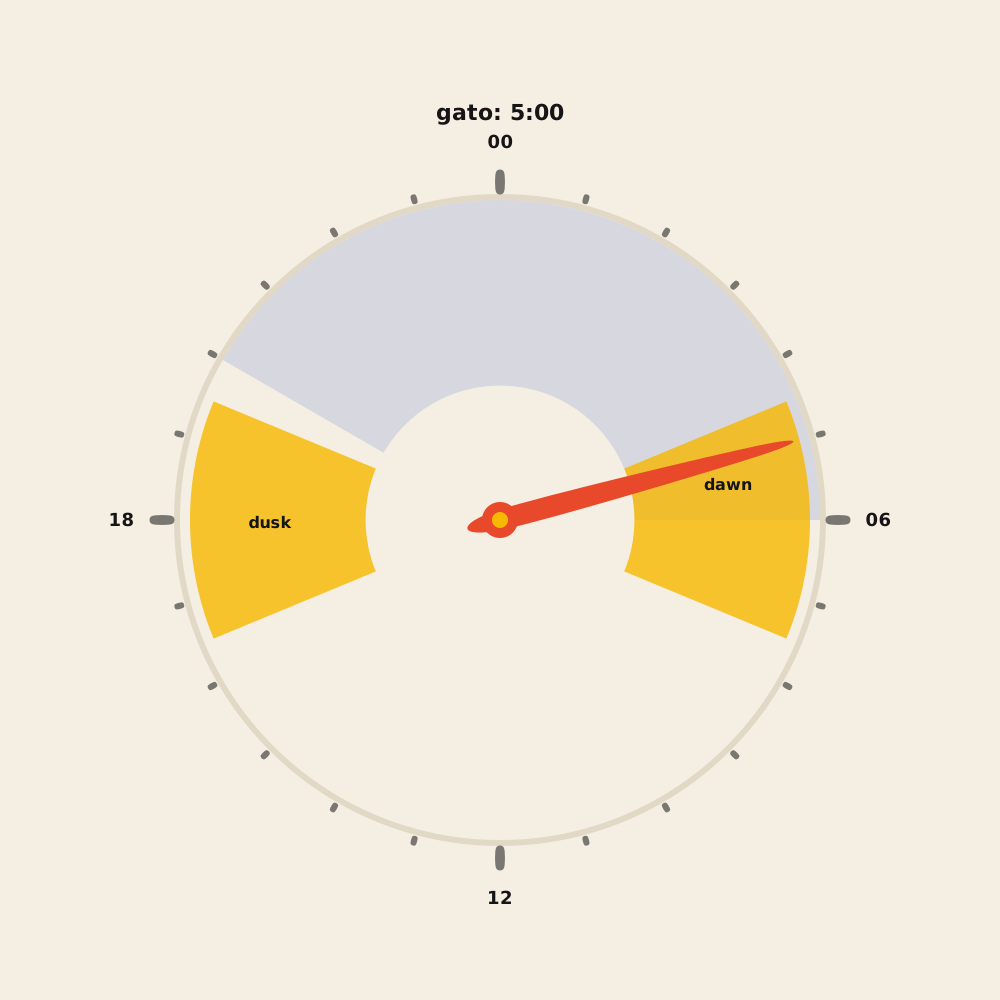
Cats are crepuscular, not strictly nocturnal, and indoor cats often shift toward the household’s day. Dawn can still be a busy hour. Sleep takes up a large share of the day, and a typical room is cooler than a cat’s comfort range.
If a cat stands on your chest before sunrise, the convenient story is that cats are nocturnal and slightly rude. The better story is about a daily rhythm, a house that may not match it, and a body that spends a large share of the day asleep — just not always when you do.
Crepuscular, and then the household happens
Cats are typically described as crepuscular: their activity tends to rise around dawn and dusk, the hours when small prey is often on the move. That is a species pattern, not a rule that every indoor cat still follows to the letter.
Housing changes the picture. Piccione and colleagues (2013), in the Journal of Veterinary Behavior, compared daily activity in cats kept in two housing conditions. Cats with a more outdoor, freer pattern were more active at night; cats living more closely with people shifted toward the human day. Other reviews of feline behavior make the same broad point: an indoor cat can entrain to your schedule, and still keep a soft peak at first light.
So a 5 a.m. wake-up is not proof that your cat “is nocturnal.” It can be a leftover dawn peak, a learned breakfast alarm, or both.
They do sleep a lot — the exact hour count is messy
Ask how many hours a cat sleeps, and you will get confident answers that do not all agree. Veterinary explainers often say twelve to sixteen hours, sometimes more. Some comparative write-ups put observational estimates lower, around ten to thirteen hours. The range itself is the honest fact: a healthy adult cat usually spends a large share of the day asleep, much of it in short bouts, and kittens and older cats may sleep even more. A single official number is not used here because the published figures do not settle on one.
Sleep is not one state. In the deeper, dreaming-like phase known as REM, skeletal muscles go slack (atonia). That is why a sleeping cat can look oddly floppy. We do not, in this article, attach a single brain structure to that fact as if it were a settled popular-science cartoon. The anatomy is real; a blog post is the wrong place to over-specify it.
The room is often too cool
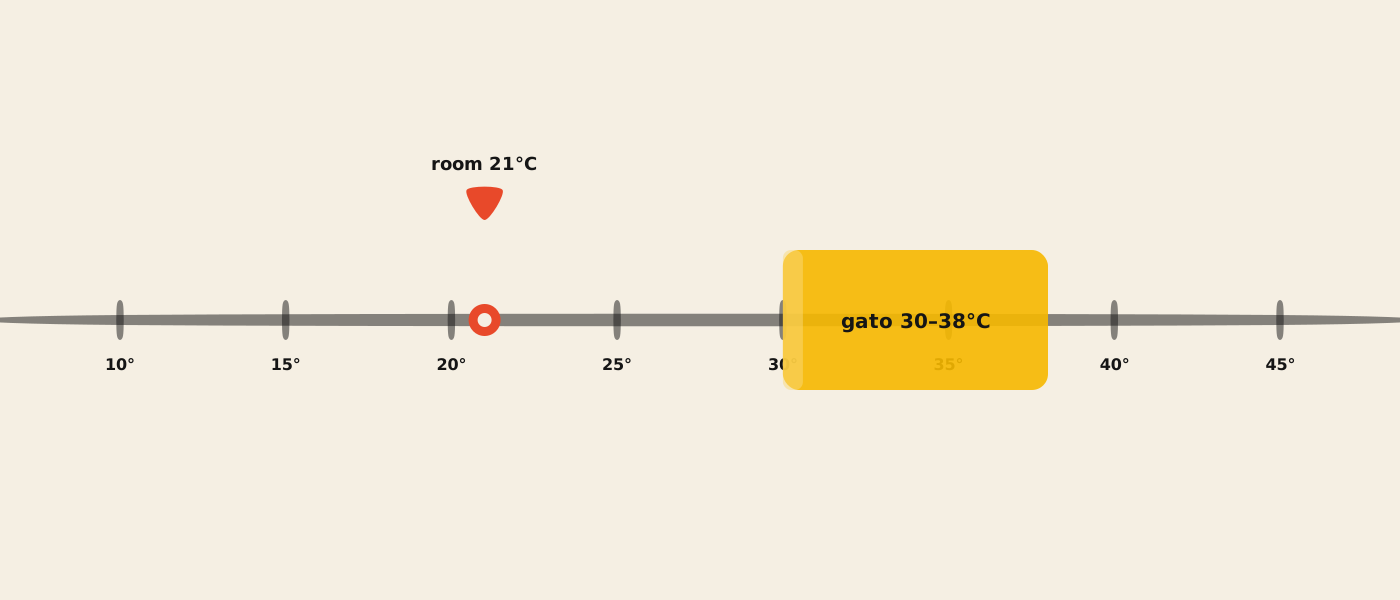
A second, under-used part of the 5 a.m. and midday story is temperature. The National Research Council’s 2006 Nutrient Requirements of Dogs and Cats gives a thermoneutral zone for cats of about 30 to 38 °C (86 to 100 °F): the range in which a cat can hold its body temperature without spending extra energy to heat or cool itself. Most homes are kept well below that, often near 20 to 22 °C. A patch of sun on the floor, a high shelf, or a person under a duvet is not a whim. It is a way to get closer to a comfortable range.
What this means at home
- If 5 a.m. has become breakfast time, feeding at that hour will keep the alarm in place. Moving the main meal, and a play session, toward evening is a common practical approach. It is a pattern to try, not a guarantee from a clinical trial.
- Offer sleep spots that are warm and slightly raised, including a bed in a sun patch if you have one.
- A sudden change in sleep — far more, far less, or a cat that seems stiff or unlike itself — is a veterinary question, not a personality change to wait out.
- Do not expect a cat to share your eight-hour block of night. Build around the peaks you can shift, and protect the ones you cannot.
Sources
- Piccione, G., et al. (2013). Daily rhythm of total activity pattern in domestic cats (Felis silvestris catus) maintained in two different housing conditions. Journal of Veterinary Behavior, 8(4). https://doi.org/10.1016/j.jveb.2012.09.004
- National Research Council. (2006). Nutrient Requirements of Dogs and Cats. Washington, DC: The National Academies Press. Thermoneutral zone for the cat given as 30–38 °C.
- Bradshaw, J. W. S. (2012). Mechanisms of behaviour. In The Behaviour of the Domestic Cat (2nd ed.). CAB International. (Circadian and activity patterns in the domestic cat.)
CritterWhy explains published research for curious readers. It is not veterinary advice and does not replace a conversation with a qualified veterinarian. If your animal seems unwell, or a habit changes suddenly, ask your vet.