How your cat actually sees you
A cat’s view of you is softer and built from a smaller palette than yours, with a third eyelid and a set of whiskers doing work the eyes cannot. Motion matters; a dead-end laser pointer has a cost.
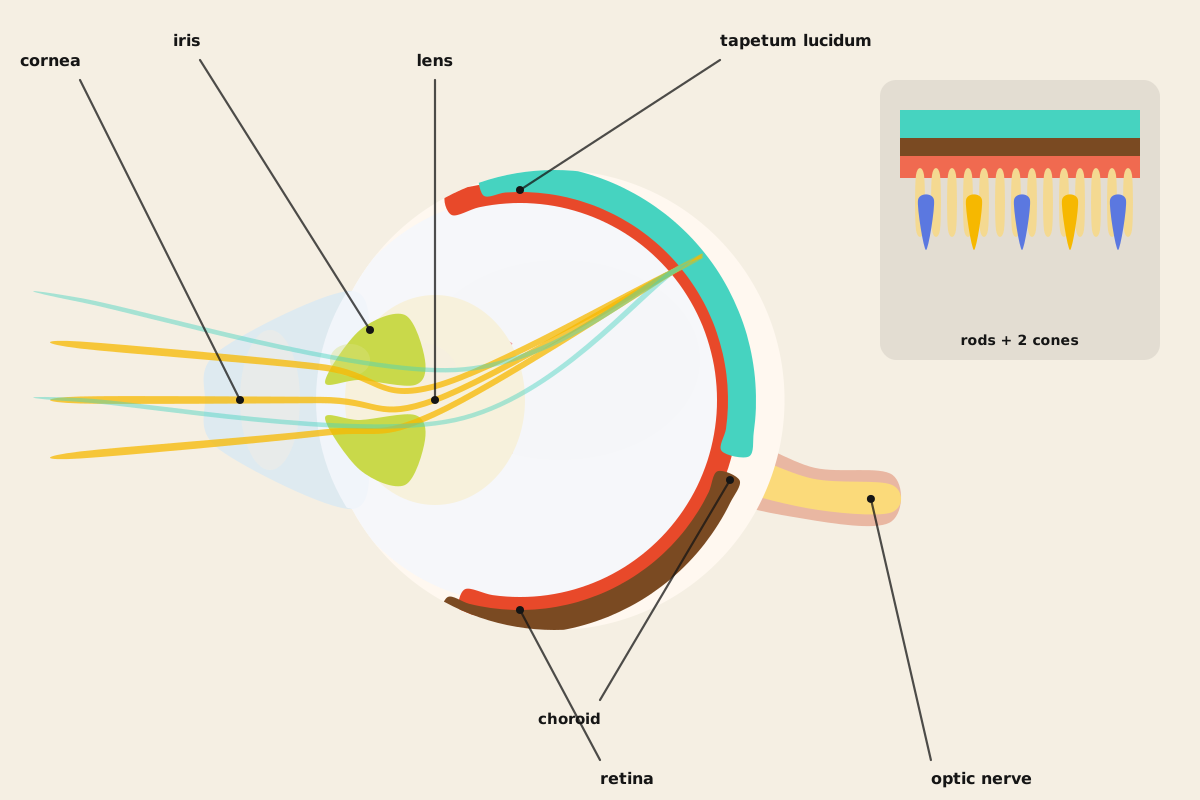
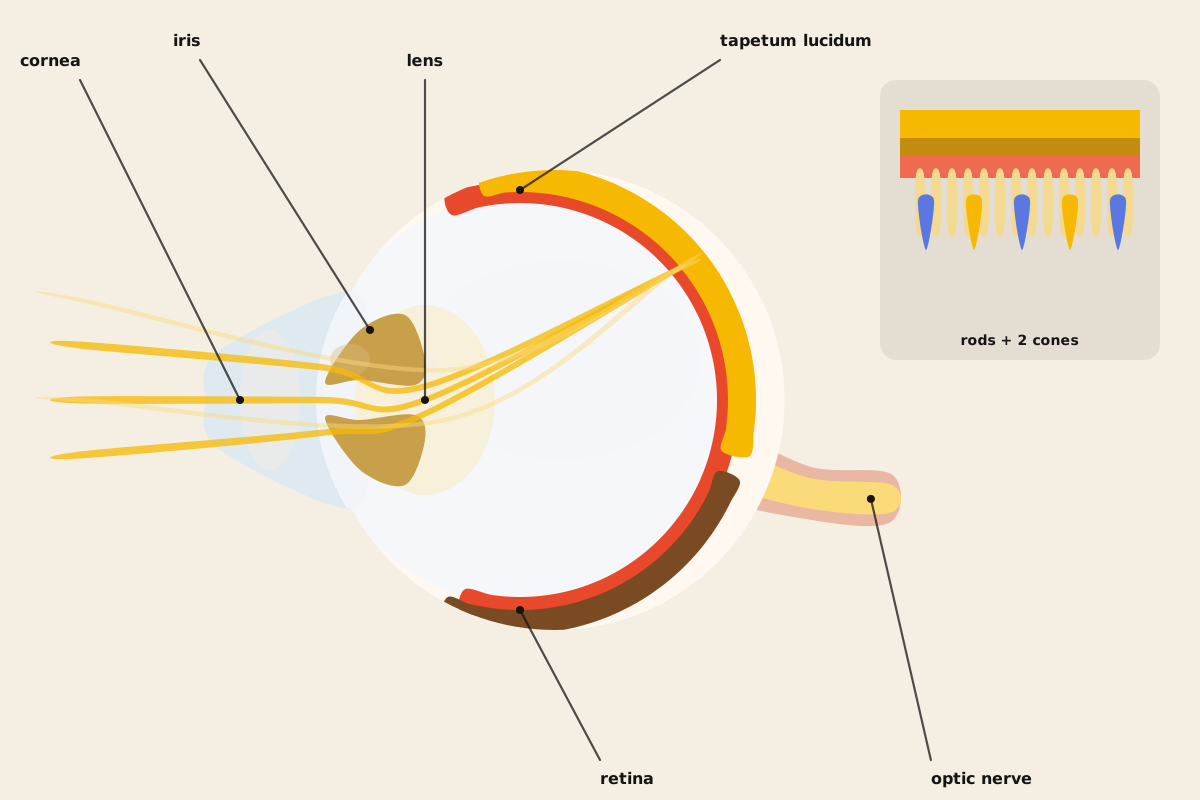
When a cat looks at you, the picture is not the one in your head. There is less detail, a smaller set of colors, and a face that can be a soft blur. The cat still knows it is you. Sight is only part of that recognition, and some of the tools it uses — a third eyelid, a fan of whiskers — barely show up in the way we talk about “seeing.”
Color, without the myth that cats “can’t see red”
Domestic cats, like dogs, appear to be dichromats. Clark and Clark (2016) trained two cats to tell monochromatic lights from grey and found that the animals could do it at some wavelengths and failed at 505 nanometers, a neutral point where a hue is confused with grey. The authors concluded that the cat is dichromatic, in a way that is loosely comparable to red–green color blindness in a person. Earlier physiology had placed cone peaks near about 560 and 460 nanometers.
That is not the same as “cats cannot see red.” Red and green are hard to tell apart. A red toy on a green cushion may be a weak contrast. It is still a visible object.
Detail, in cycles, not in a borrowed eyeglass prescription
Cat acuity is usually reported in cycles per degree, not in the 20/20 language used for human eye charts. Reviews of behavioral work often put ordinary performance in a range of about 3 to 9 cycles per degree; under ideal, high-contrast conditions, figures around 12 cycles per degree have been reported (discussed in Clark and Clark, 2013). Human 20/20 is defined as 30 cycles per degree. Translating a cat’s acuity into a single “20/something” number, as some secondary articles do, adds precision that the measurements do not actually give, so we will not use one here.
The field of view is wide. Summaries used in veterinary teaching, including a 2012 Tufts Catnip piece, put a cat’s visual field at about 200 degrees, against about 180 for a person, with binocular overlap around 120 to 130 degrees. Treat those as approximate.
Motion does a lot of the work. Neurons in the cat’s superior colliculus respond strongly to moving stimuli, and untrained cats will track or intercept a moving target with their eyes. A toy that stops “dying” in the middle of the rug often stops being interesting. That is a common observation, not a formal law, but it is consistent with a visual system tuned to prey that moves.
Whiskers, and the third eyelid
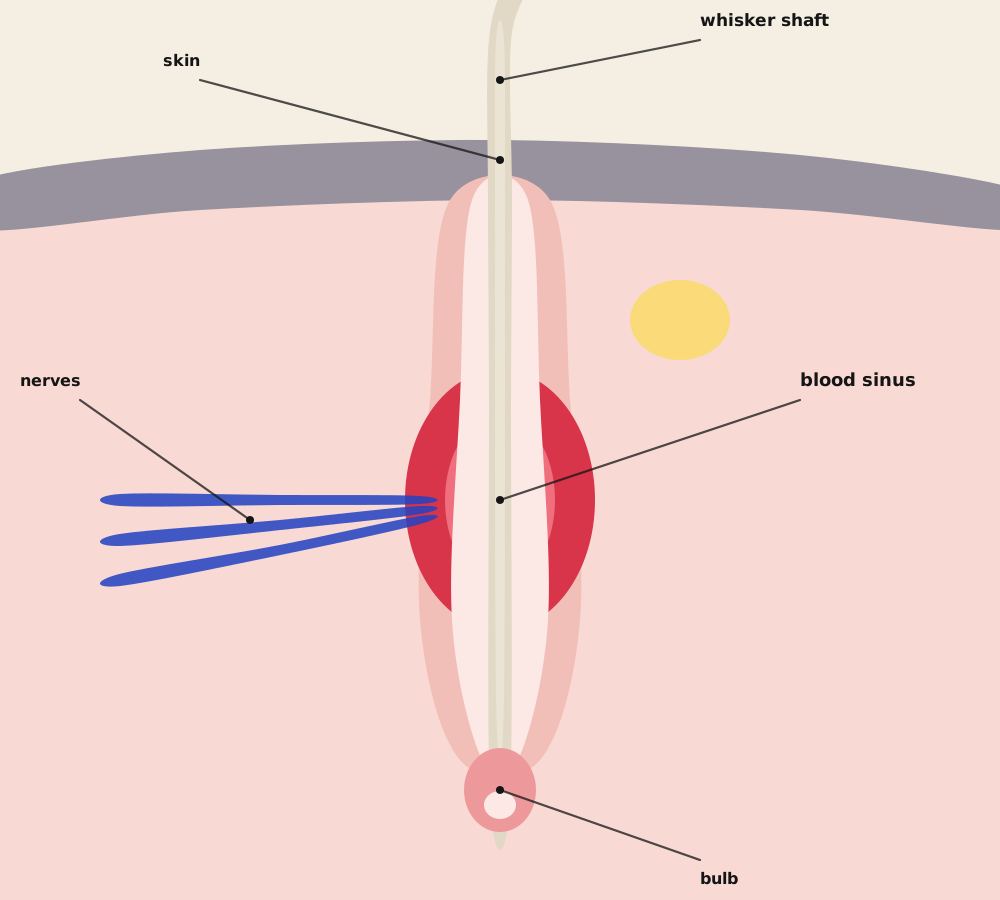
Whiskers are tactile sensors. They can also pick up the disturbance of air around a nearby object, which is one reason a cat can move through a tight space without a full visual survey (a point made in ordinary veterinary explainers, such as VCA’s overview of whisker function). Some popular videos claim a hard cutoff — that a cat cannot focus closer than a set number of centimeters — and the sources do not agree, so that number is not used here.
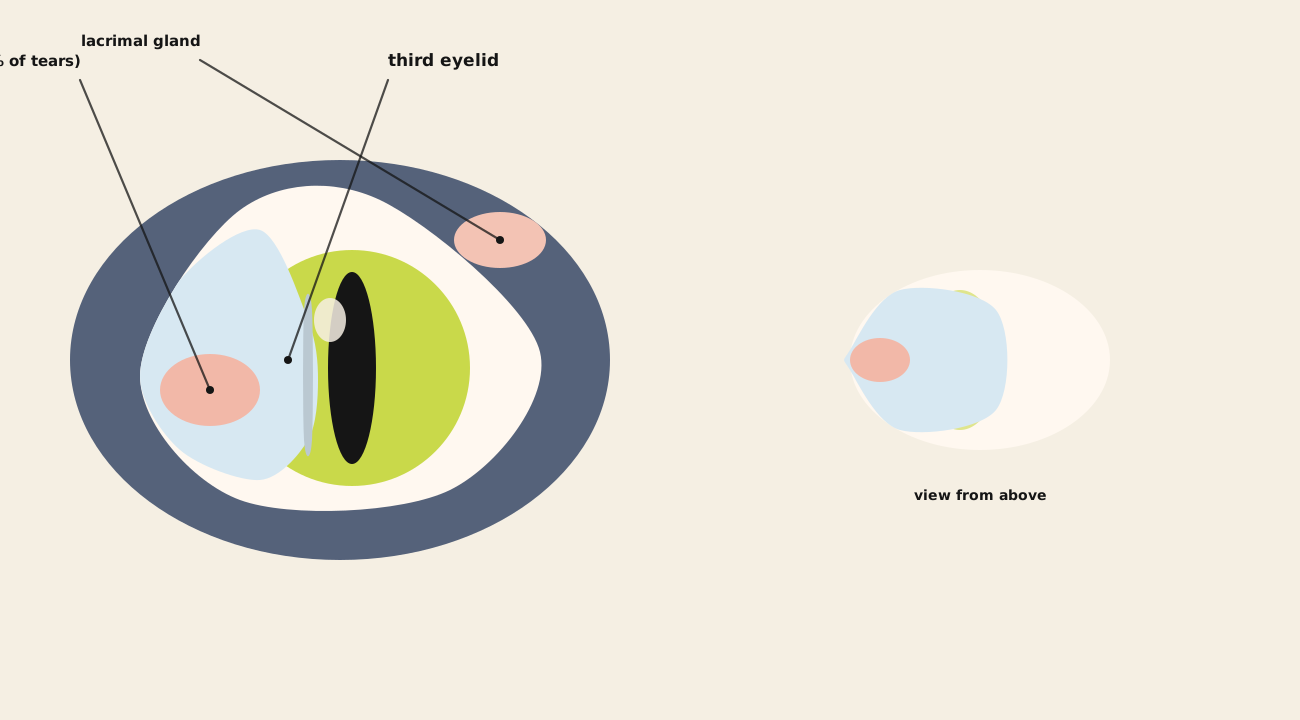
The third eyelid — the nictitating membrane — is a pale sheet that can sweep across the eye. It helps protect the surface, for example in rough vegetation or during a catch, and the gland associated with it produces a substantial share of the tear film (on the order of half, in morphological work on the cat’s nictitating membrane). If you can see a lot of that membrane while the cat is awake and at rest, that is a reason to ask a veterinarian. It is not a diagnosis in a blog post.
The laser, and how a cat knows you
A 2021 survey of 618 caregivers found that 45.5 percent used a laser pointer in play, and that laser play was associated with repetitive behaviors such as chasing lights or shadows. The authors were careful: the link is correlational, and a laser has no body to catch. If you use one, end the session with a toy the cat can actually seize.
Recognition is not only visual. Saito and Shinozuka (2013) found that cats responded differently to their caregiver’s voice than to a stranger’s. A later test by Takagi and colleagues (2019) suggested that, after hearing a caregiver’s voice, cats in a cat café seemed to expect that person’s face on a monitor; house cats in the same paper did not show the effect. So: a cat can know your voice. Whether it always pictures your face is still a narrower, unfinished result.
What this means at home
- Move the toy. A still object is easier to ignore, even if you can see it clearly.
- Choose contrast the cat can use. Blue or something that does not sit on a similar-colored blanket will do more than a “brighter red.”
- If you play with a laser, finish with a catchable toy.
- Leave the whiskers alone, and treat a visible third eyelid at rest as a veterinary question.
Sources
- Clark, D. L., & Clark, R. A. (2016). Neutral point testing of color vision in the domestic cat. Experimental Eye Research, 153, 23–26. https://doi.org/10.1016/j.exer.2016.09.002
- Clark, D. L., & Clark, R. A. (2013). Revisiting grating acuity in the domestic cat. Experimental Eye Research.
- Saito, A., & Shinozuka, K. (2013). Vocal recognition of owners by domestic cats (Felis catus). Animal Cognition, 16, 685–690. https://doi.org/10.1007/s10071-013-0620-4
- Takagi, S., et al. (2019). Cats match voice and face: cross-modal representation of humans in cats. Animal Cognition, 22, 901–906. https://doi.org/10.1007/s10071-019-01265-2
- Kogan, L. R., & Grigg, E. K. (2021). Laser light pointers for use in companion cat play: association with guardian-reported abnormal repetitive behaviors. Animals, 11(8), 2178. https://doi.org/10.3390/ani11082178
- Functional morphology of the nictitating membrane in the domestic cat. PubMed 8304584
CritterWhy explains published research for curious readers. It is not veterinary advice and does not replace a conversation with a qualified veterinarian. If your animal seems unwell, or a habit changes suddenly, ask your vet.