How your dog actually sees you
Not in black and white, and not as sharply as you do. A typical dog’s world is built from blues and yellows, is a little soft at the edges, and lights up for motion — while the version of you it knows best is made of scent.
Your dog has never seen your face the way you think it does. It sees fewer colors, less sharp detail, and a wider slice of the room. It is also much better than you are at spotting something that moves in the distance. And when it greets you at the door, the sense that does most of the work is not the eye.
Color is real — the palette is smaller
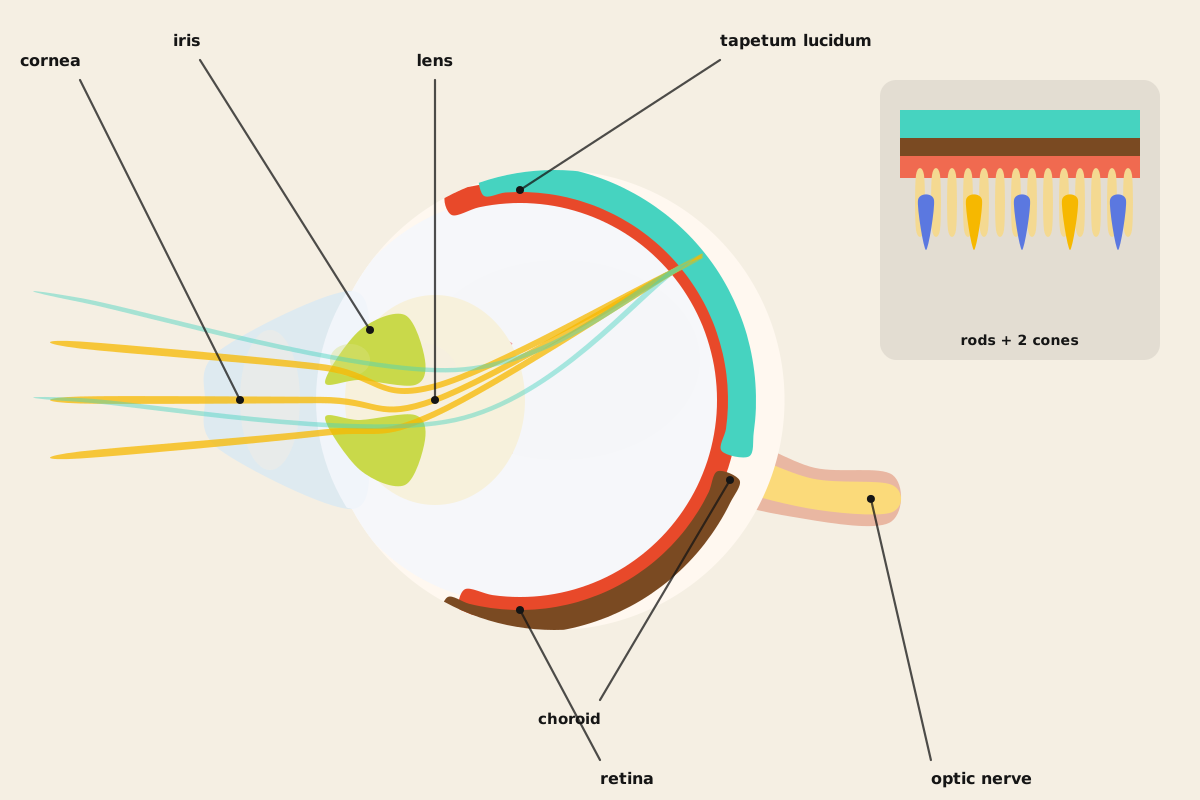
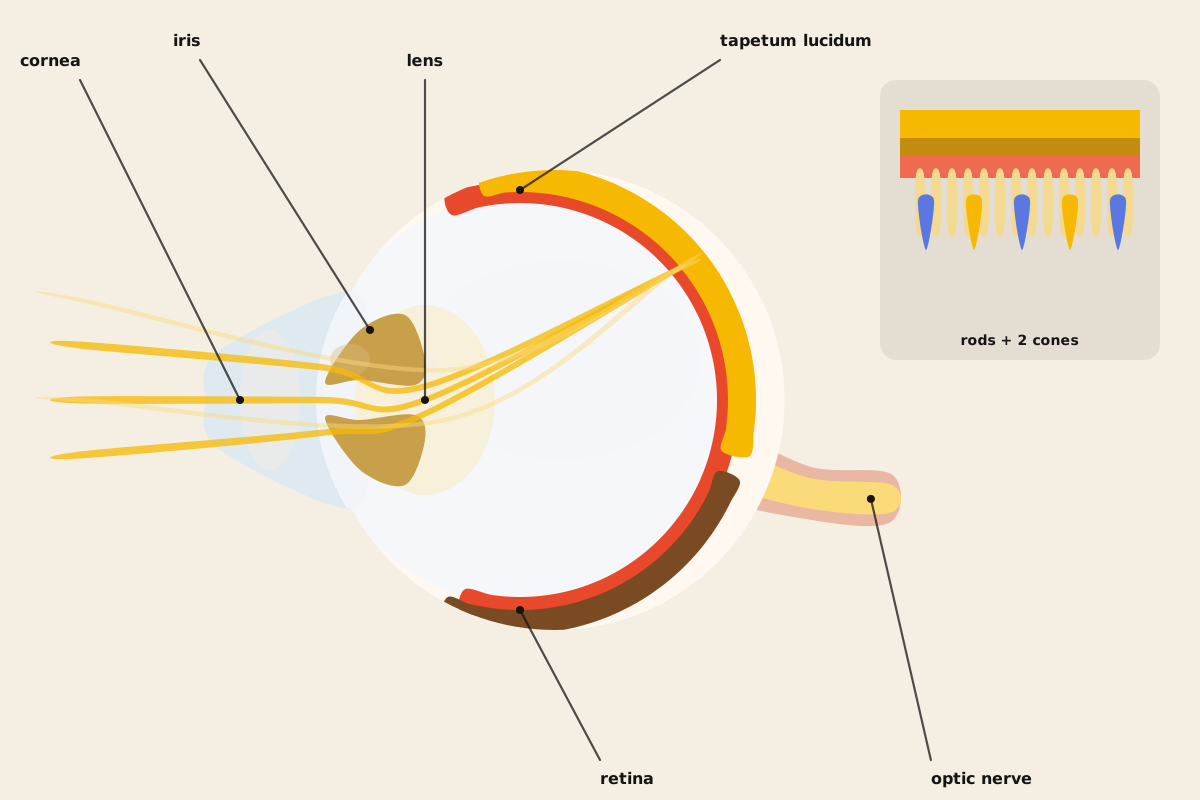
Dogs are not color-blind in the everyday sense of seeing only grey. They have two types of cone cell, the cells that handle color, instead of the three that most people have. In 1989, Jay Neitz, Timothy Geist, and Gerald H. Jacobs measured those pigments with colored lights and found peaks near 429 nanometers (violet-blue) and 555 nanometers (yellow-green).
A later veterinary review by Paul E. Miller, drawing on that work, describes the practical result this way: light from about 430 to 475 nanometers looks blue; light from about 500 to 620 nanometers — which to you may be green, yellow, or red — looks yellowish; and a narrow band around 480 nanometers is likely to look grey. The colors are also less saturated than they are for you.
So a red sweater and a blue leash are not equally clear. The leash stands out. The sweater is probably a duller, darker yellow. A bright red ball on green grass is a special case of the same problem: both the ball and the grass fall in the part of the spectrum a dog sees as yellowish, so the toy can melt into the lawn. Blue toys, and yellow toys on green grass that is actually green, are easier to see.

Softer, and worse up close
Veterinary ophthalmologists often put a typical dog’s acuity at about 20/75. In Miller and Murphy’s 1995 review, that means a detail you could make out from 75 feet away, a typical dog has to get within about 20 feet to see. The lens also changes focus very little (about two to three diopters), so something closer than roughly a foot or a foot and a half is probably a smear. The treat against the nose is a job for the nose, not the eye.
That is a typical figure, not a law for every breed or every study. Later reviews, including Byosiere and colleagues in 2018, still place dog acuity well below human 20/20, with published estimates often falling somewhere around that mid-70s range in Snellen terms.
Motion, and a wider world
If the picture is softer, how does a dog lock onto a squirrel across a park? Motion. Miller, summarizing a 1936 study of 14 police dogs, notes that the most sensitive of those dogs could recognize a moving object from about 810 to 900 meters, but only from 585 meters or less when the same object was still. That is one old study, not a modern census of pet dogs, but it matches a broader point: a dog’s eye is built to catch movement.
The eyes also sit farther to the side than yours. A typical dog sees about 240 degrees around itself; you see about 180. The tradeoff is depth. Only about 30 to 60 degrees of a dog’s view are covered by both eyes at once, compared with about 140 degrees for you. A squirrel can move behind your dog’s shoulder and still be in view. Judging exact distance is harder.
The same speed shows up on a screen. Dogs can detect flicker at 70 to more than 80 flashes per second (Coile and colleagues, 1989, cited in Miller’s review). Older televisions refreshed about 60 times a second, which may have looked like a rapid flicker to a dog. Many newer screens refresh faster. Even then, a dog running across the frame is far more likely to hold the eye than two people talking.
Night, and that green-eye glow
The glow in a flash photograph has a name: the tapetum lucidum. In dogs it sits in the upper half of the back of the eye (Granar, Narfström, and colleagues, 2011). Light that slips through the retina hits this layer and bounces back, so the retina gets a second chance. The retina is also rich in rods, the cells that work in dim light. The cost is detail, and in very low light there is not enough left for the cones, so most of the color drops out.
Your dog does know your face — it does not lead with it
Dogs can connect your voice to your face. In 2007, Adachi, Kuwahata, and Fujita played dogs a recording of their owner or of a stranger, then showed a face on a screen. When the face did not match the voice, the dogs looked longer, as if something was off. Hearing you seems to call up a picture of you.
That still is not the main way a dog knows you. Inside the nose, air is split: most of it goes down toward the lungs, and a separate stream is sent back into a pocket of scrolled bone, the ethmoturbinates, where odor is caught (Craven, Paterson, and Settles, 2010). Popular summaries often put a dog’s odor receptors in the range of about 200 to 300 million, against about five or six million in people; treat that as a range from secondary sources, not a census of every nose.
The brain gives your smell special treatment. In 2015, Berns, Brooks, and Spivak trained 12 dogs to lie still, awake, in an MRI scanner and presented five scents, including a familiar person who was not in the room. The caudate nucleus — a region strongly tied to reward and positive expectation — responded most to that familiar human. The authors warned against reading a single brain area as proof of a feeling. What the scan shows is a positive association with your smell, even when you are not there.
What this means at home
- If your dog runs past a red toy on the lawn, try a blue one before you assume it is ignoring you.
- Move when you want to be noticed at a distance; stand still, and you are easier to miss.
- A dog that ignores the television may simply be watching a different show than you are.
- The greeting at the door is built from scent as much as from the face you present.
Sources
- Neitz, J., Geist, T., & Jacobs, G. H. (1989). Color vision in the dog. Visual Neuroscience, 3(2), 119–125. https://doi.org/10.1017/s0952523800004430
- Miller, P. E., & Murphy, C. J. (1995). Vision in dogs. Journal of the American Veterinary Medical Association, 207(12), 1623–1634. PubMed
- Miller, P. E. (2001). Vision in animals — what do dogs and cats see? Waltham/OSU Symposium. Summary of color ranges, acuity, flicker, and field of view used above.
- Byosiere, S.-E., Chouinard, P. A., Howell, T. J., & Bennett, P. C. (2018). What do dogs (Canis familiaris) see? A review of vision in dogs and implications for cognition research. Psychonomic Bulletin & Review, 25, 1798–1813. https://doi.org/10.3758/s13423-017-1404-7
- Coile, D. C., Pollitz, C. H., & Smith, J. C. (1989). Behavioral determination of critical flicker fusion in dogs. Physiology & Behavior, 45(6), 1087–1092.
- Granar, M. I., et al. (2011). Quantitative assessment of the canine tapetum. Acta Veterinaria Scandinavica, 53, 13.
- Adachi, I., Kuwahata, H., & Fujita, K. (2007). Dogs recall their owner’s face upon hearing the owner’s voice. Animal Cognition, 10, 17–21. https://doi.org/10.1007/s10071-006-0025-8
- Craven, B. A., Paterson, E. G., & Settles, G. S. (2010). The fluid dynamics of canine olfaction: unique nasal airflow patterns as an explanation of macrosmia. Journal of the Royal Society Interface, 7, 933–943. PMC2871809
- Berns, G. S., Brooks, A. M., & Spivak, M. (2015). Scent of the familiar: an fMRI study of canine brain responses to familiar and unfamiliar human and dog odors. Behavioural Processes, 110, 37–46. https://doi.org/10.1016/j.beproc.2014.02.011
CritterWhy explains published research for curious readers. It is not veterinary advice and does not replace a conversation with a qualified veterinarian. If your animal seems unwell, or a habit changes suddenly, ask your vet.